Four operational situations the kit was designed to make routine — drawn from how users actually deploy it forward.
Scenario · 01
When three classifications have to land on one kit.
A forward intelligence team needs simultaneous access to NIPR, SIPR, and TS/JWICS from the same site — without three sets of hardware, three vendor stacks, and three integration cycles. The traditional path is to stack point solutions; the operational path is to bring one box that does all three.
What JEFF-K makes possible: three-enclave architecture in a single integrated chassis — full-spectrum intelligence operations without duplicate systems at the forward location.
Scenario · 02
When the transport keeps changing under you.
Day one is SATCOM. Day two is a wired enterprise link. Day three is cellular through a contested area. Each leg of the deployment uses a different transport, and the gear has to keep up without a re-cable.
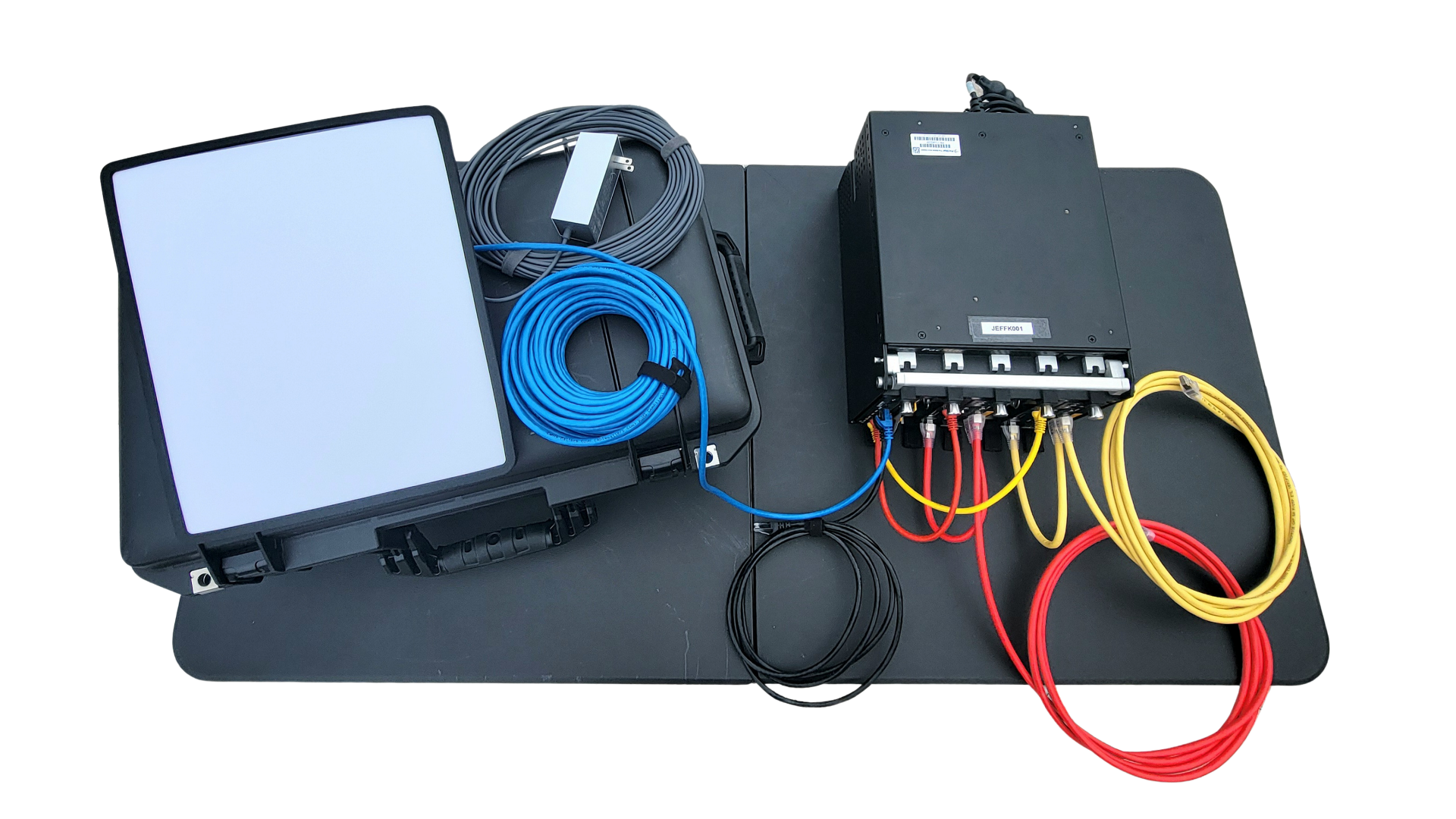
What JEFF-K makes possible: dual PacStar routers with SATCOM, Ethernet, and 5G transports through one chassis — PACE-ready by design, no swap required.
Scenario · 03
When the kit has to fly tomorrow.
The mission window opened overnight. The kit needs to be packed, shipped, and operational at a forward site within the duty cycle. There's no time for custom palletization, no FSR sitting at the destination, no specialist coverage at the receiving end.
What JEFF-K makes possible: a ruggedized Pelican case with wheels and adjustable handle, single AC/DC input, worldwide voltage — ready to fly, ready to power up wherever it lands.
Scenario · 04
When the configuration gets corrupted forward.
A kit takes a hit — bad config push, hardware glitch, an operator error during a long shift. The nearest SME is two time zones away. The mission can't wait for a callback. The team needs to bring the kit back online themselves, today.
What JEFF-K makes possible: MANTLE-powered automation that restores a corrupted configuration in under an hour, executed by an operator with no specialized IT background.