Four operational situations COMPASS was designed to make routine. Drawn from real engagements across SOF, joint task forces, federal LE, and the emerging unmanned fleet.
Scenario · 01
When the video can't wait.
A mission needs live ISR video in the hands of decision-makers, analysts, or partners inside a hard operational window. But the feed is trapped on the wrong network, at the wrong classification, or running over the most expensive transport on the bill.
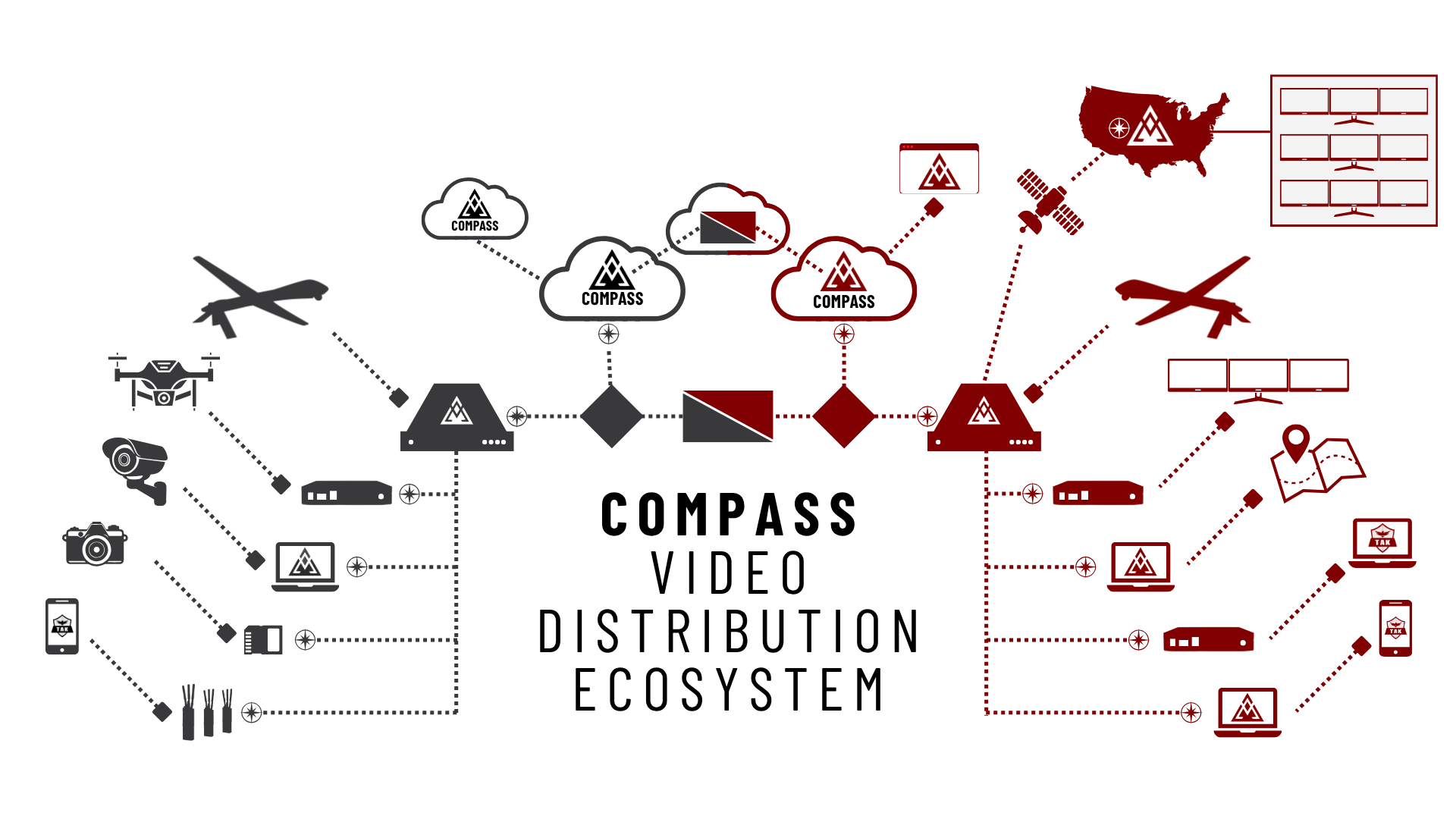
What COMPASS makes possible: live video delivered over the best available transport, normalized in flight, and shared with permission-based access — inside the window that matters.
Scenario · 02
When the video has to cross the wire.
A tactical feed needs to reach a different network — analysts at a higher classification, coalition partners on a separate enclave, or an enterprise destination across a cross-domain solution. The usual path is manual transfer, custom integration, or a deployable CDS that isn't on station.
What COMPASS makes possible: secure delivery to a remote COMPASS node, KLV remediation through approved cross-domain partners, and automated distribution into the destination network.
Scenario · 03
When the network is denied or degraded.
Tactical radios with limited throughput. SATCOM that comes and goes. The feeds still need to reach commanders, analysts, and AI/ML pipelines at multiple classification levels — and they need to get there in real time.
What COMPASS makes possible: real-time compression from 10+ Mbps to under 1 Mbps, KLV-aware routing across whatever transport is available, and seamless handoff to TAK, PED, and machine-learning destinations.
Scenario · 04
When the sensors keep multiplying.
A growing population of mission sensors — drones, body-worn cameras, unmanned platforms, IP cameras — each from a different vendor, each with different codecs and protocols. The common operating picture needs them all, normalized, in real time, without a custom integration for every new source.
What COMPASS makes possible: sensor- and platform-agnostic distribution across the entire fleet, with a common, repeatable architecture from edge to enterprise.