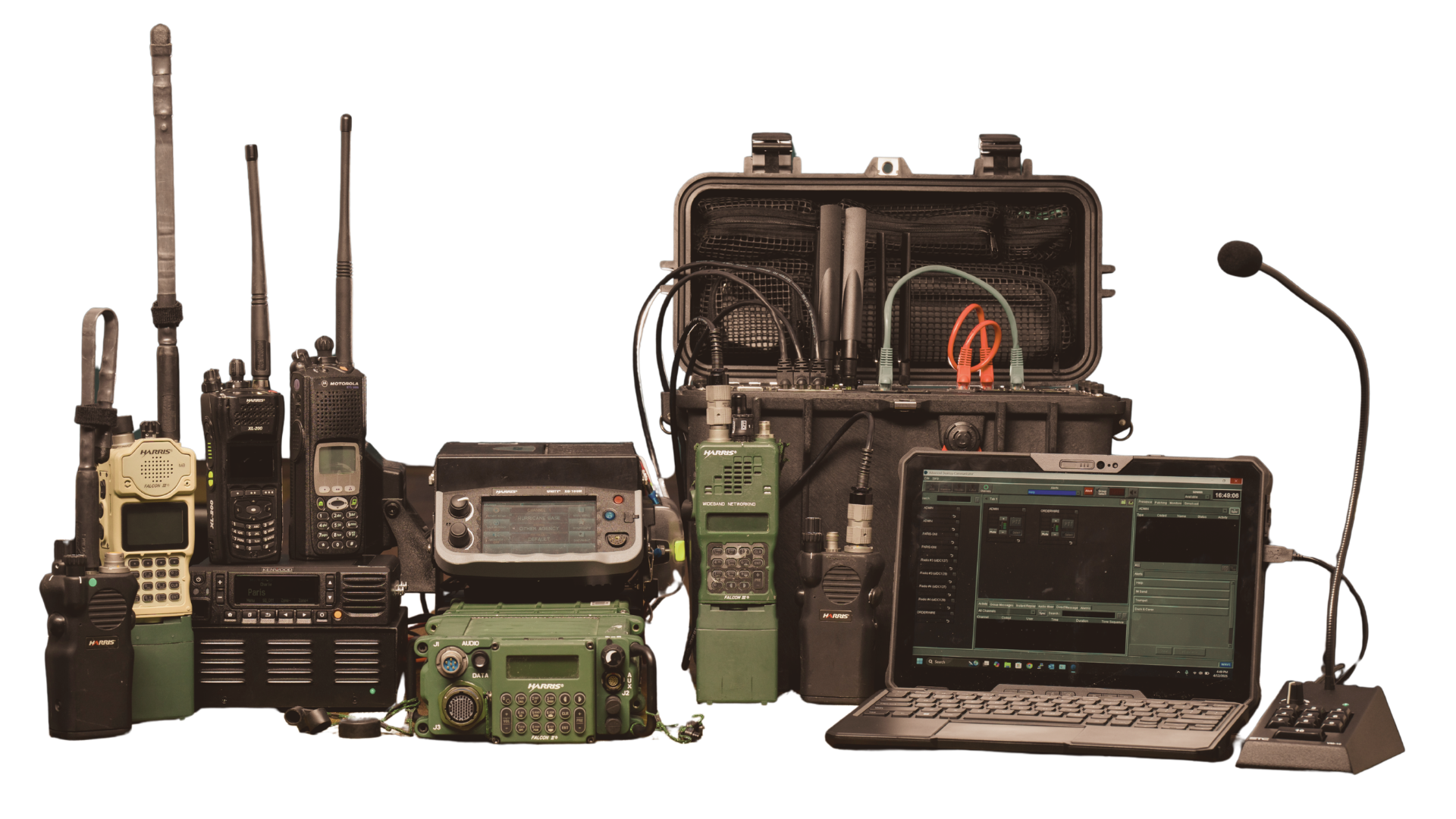
Four situations where one radio plane isn't enough — and rip-and-replace isn't an option. The IDC Kit was designed to make routine what used to require custom integration on every deployment.
Scenario · 01
When every agency has a different radio.
An incident draws in three agencies and two units of military support. Each has its own radio system. Each system speaks a different protocol. Dispatchers need to push one common picture to everyone, in real time, without forcing a vendor migration on any of them.
What IDC makes possible: every radio on one console — tactical military, Land Mobile Radio, federal nets, local LE — federated through a single CAD framework with no rip-and-replace.
Scenario · 02
When the dispatch op has to ship overnight.
A planned event becomes an unplanned operation. The team needs a full dispatch capability stood up at a remote site by tomorrow morning — wheeled in, plugged into power, and operating without specialist support on the ground.
What IDC makes possible: a ruggedized one-person-lift wheeled case with worldwide voltage support. Operational the day it lands.
Scenario · 03
When the WAN can't be one provider.
The site has fiber, but the cable cuts twice a year. Cellular works most days. SATCOM is the fallback. The dispatch operation can't ride or die on any single transport — it has to switch automatically when something drops.
What IDC makes possible: DIN, Starlink, and Cellular/FirstNet failover paths in one chassis. Secure, resilient connectivity with no single point of failure.
Scenario · 04
When the spectrum is crowded.
Multiple radio nets running simultaneously in the same enclosure. Interference is real, isolation matters. Some operators want the radio gear physically separated from the dispatch core; others need everything in one box.
What IDC makes possible: modular RF isolation in groups of four, with single- or multi-mode fiber between modules. Co-locate or physically separate — your call, on the day.